

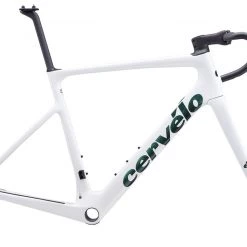
Cervelo R5 Frameset – Five Black 2022 | Road Bike Frames
Original price was: $555.00.$91.99Current price is: $91.99.
- SSL encryption, absolutely safe shopping
- Superior Quality Goods
- Safe Transactions, Always
- The home of quality products.

WHAT GOES UP MUST COME DOWN
R5 has one job—get to the top, fast. But for all the glory and fanfare that comes with a summit finish, they’re rarely the only climb of the day. And while a race isn’t usually won on a descent, they can certainly be lost. A climbing bike that can’t carve a hairpin is a bit like a cup of decaf coffee. This is the fourth iteration of the R5, and while weight and stiffness have varied over the years, the handling, poise, and unmatched prowess on a descent have been consistent since day one.
FASTER IN EVERY DIRECTION
The new R5 frame is 130g lighter than the previous model—a 16% reduction from an already-light frame. And while aerodynamics weren’t a focus with this frame the way they would be on an S5 or P5, bringing the cables inside reduced drag by 25g.
AERODYNAMICS
Aerodynamics is at the very core of what we do at Cervélo. The company was founded with the goal of making cyclists faster, and using aerodynamics is the best way to achieve that goal. We take a system approach to aerodynamics, considering the bike, rider, and all components together. A bike never rides itself, and so we don’t design or test our bikes without a rider. It means that our bikes are not just fast in the wind tunnel, but fast out on the road with you as well.
Aerodynamic drag is the major factor affecting a bike and rider – it can account for up to 90% of the overall resistance that a rider must overcome. There are several types of drag relevant for us. First, pressure drag. As a body (in this case a bike and rider) passes through the air, it forces the air molecules to move out of the way in order to pass through them. These molecules push back on the body, creating pressure. The component of this pressure that faces aft (to the rear of the body) is called pressure drag.
Secondly, there is friction drag. Air, like all fluids, has viscosity (or “thickness”). The air molecules that come into contact with the body stick to its surface and stay stationary in relation to the body. As the body continues through the air, other air molecules pass by the stuck molecules as they flow around the body in layers, following parallel paths. This is the laminar boundary layer. The viscous nature of air creates a shear force, or friction drag.
At some point on nearly all bodies, laminar flow cannot be maintained and the air molecules tumble and mix instead of flowing smoothly. The transition point is where this turbulent boundary layer begins. This behaviour of flow is related to a parameter called the Reynolds number, which is determined by several physical characteristics of the flow. The laminar flow regime exists up to Reynolds numbers of around 10,000. Beyond Reynolds numbers of 10,000, the flow transitions to “turbulent” flow, as shown in the figure below
| Brand | Cervelo |
|---|---|
| Type | Road Frames |
| Color | Matte Black |
| Size CM | 48cm |
| Size | XS |
| Gender | Unisex |
| Material | Carbon |
| Item condition | New |
| Availability | In-store |
Be the first to review “Cervelo R5 Frameset – Five Black 2022 | Road Bike Frames”
Related products




Reviews
There are no reviews yet.